
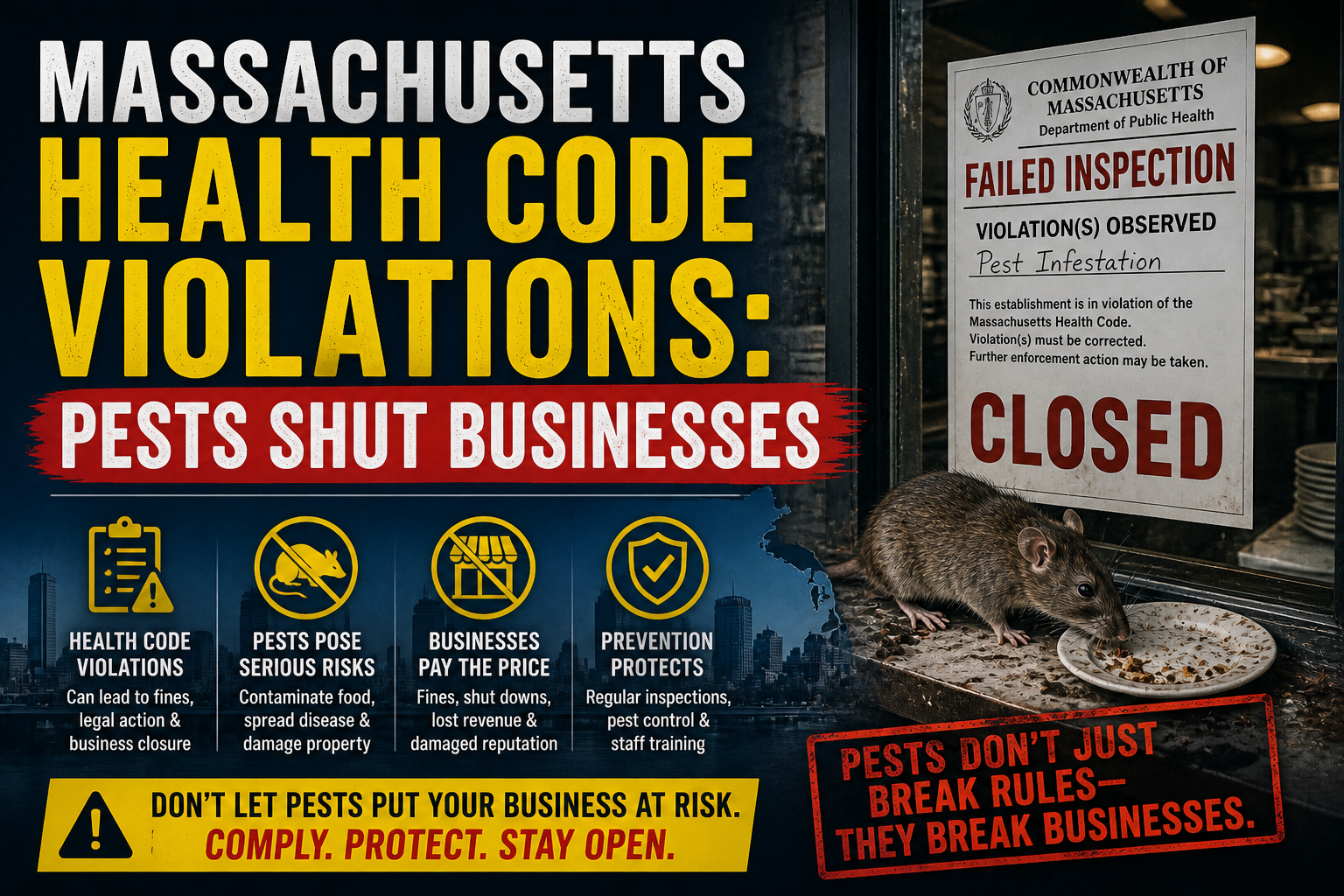
If you own or manage a food business, a restaurant, a hotel, a daycare, or any commercial establishment in central Massachusetts, pests are not just a sanitation inconvenience. Under Massachusetts law, they are grounds to shut your doors immediately, without a hearing, without warning, and without any grace period.
That is not an exaggeration. That is what the law actually says.
Understanding how Massachusetts health code violations related to pest activity work, what inspectors look for, and what happens when they find something is one of the most practical things a business owner in the Greater Boston or central Massachusetts area can do right now.
What Massachusetts Law Says About Pests in Commercial Businesses
Massachusetts food establishments are governed by 105 CMR 590.000, the State Sanitary Code Chapter X, commonly known as the Massachusetts Merged Food Code. This regulation applies to every food business in the state, from a corner lunch spot in Worcester to a catering operation in Framingham.
The code is direct: pest-free premises are not optional. The food code requires businesses to control pests through four specific methods: chemical controls, physical exclusion, sanitation practices, and mechanical trapping. You need all four. Using one without the others does not meet the standard.
The Massachusetts Board of Health, operating under M.G.L. c. 111 and guided by the Massachusetts Association of Health Boards, has clear authority to issue orders for compliance, revoke permits, and take enforcement action for rodent infestations. Local boards of health across the state, from Boston to Worcester to Lowell, operate under the same framework.
Here is the part that catches most business owners off guard. Under 105 CMR 590.014, the board of health can suspend your permit without prior notice, without a hearing, and without advance warning if an inspector determines that an imminent health hazard exists. A summary suspension order takes effect immediately when it is posted on your front door. You can request a hearing, but that request must be filed within ten days, and your business stays closed until the issue is resolved and confirmed through reinspection.
One rat. One cockroach in the prep area. That can be your imminent health hazard.
What Massachusetts Health Inspectors Actually Check for Pest Activity
Boston's Health Division, which operates under the Department of Inspectional Services, ensures that all food businesses comply with state and federal food codes. Inspectors are not just looking for live pests during a visit. They are trained to read a facility like a book.
Outside the Building
Inspectors look at the exterior first. Damaged foundation walls, gaps around utility penetrations, missing door sweeps, improperly sealed loading docks, and dumpster areas that are not being maintained all appear on their checklist. Under Massachusetts food code standards, gaps larger than a quarter inch around pipes and entry points are a cited violation. That is smaller than a pencil eraser.
Storage Areas and Back of House
Droppings along walls, gnaw marks on packaging, evidence of nesting in stacked goods, and improperly stored product are all documented. Food must be stored at least six inches off the floor in sealed containers. Inspectors know exactly where rodents travel and where cockroaches harbor. They look at the corners you do not clean behind, the space under the dish machine, the gap beside the walk-in cooler motor.
Documentation
Here is the part that surprises a lot of Massachusetts business owners. An inspector does not just want to see a pest-free facility on the day they visit. They want to see evidence of an ongoing pest management program. Verbal confirmation that you have a pest control service provider coming does not satisfy this requirement.
Written service records, post-application disclosure forms from your licensed applicator, and documented corrective actions are what inspectors review. Under 333 CMR 13.08, licensed pesticide applicators in Massachusetts are required to provide notice of pesticide applications and retain documentation. If your pest control provider is not giving you written reports after every single visit, you are already partially out of compliance before an inspector walks through the door.
The Real Cost of a Massachusetts Health Code Violation for Pest Activity
Most business owners think about the fine first. The fines are real, and under local town regulations adopted alongside 105 CMR 590, they can reach $1,000 per violation under noncriminal disposition processes. Repeat violations carry escalating penalties.
But the fine is almost never the biggest cost.
Closure and Lost Revenue
A summary permit suspension under Massachusetts health code stays in effect until the violations are corrected and confirmed by reinspection. There is no standard timeline for how long that takes. It depends on the severity of the issue, the availability of the inspector for reinspection, and how quickly you can remediate. A business that closes on a Friday before the dinner rush and cannot reopen until Wednesday has lost four or five days of revenue. For a restaurant generating $5,000 to $15,000 a week, that is not a small number.
Reputation Damage That Outlasts the Closure
Boston operates the Mayor's Food Court, an online database that tracks inspection results for every food service business in the city. Inspection records are public. Journalists and food bloggers check this data. Yelp reviews reference it. A closure order, even one that gets resolved quickly, becomes a searchable fact attached to your business name.
Pest infestations can trigger negative online reviews, customer loss, and lasting brand damage. According to Ecolab research cited by A1 Exterminators, pest activity poses serious risks to food establishment safety and reputation that extend well beyond the inspection visit. When customers read that a restaurant was closed for rodent activity, many of them do not come back. That loss does not show up on an inspection report, but it shows up in your revenue for months.
The Mandatory Consultant Order
In serious cases, the Massachusetts Association of Health Boards has clarified that local boards can order a food establishment to hire a certified food safety consultant. This order is typically based on documented violations including pest infestations, unsanitary food handling, and failure to meet temperature standards. The cost of that consultant comes out of your pocket, on top of whatever remediation work your facility requires.
Health Code Violations and Pest Management: What Applies to Non-Food Businesses
Food establishments get the most attention when it comes to pest-related health code violations in Massachusetts, but they are not the only businesses at risk. The issues faced in warehouses and distribution centers are similarly heavily regulated.
The Massachusetts Sanitary Code Chapter II, 105 CMR 410.000, covers residential and commercial property standards. Under these regulations, property owners with multiple-unit buildings are responsible for exterminating all rodents, cockroaches, and insect infestations. This applies to commercial landlords, mixed-use building owners, and property managers across central Massachusetts.
Daycares, nursing homes, hospitals, and camps for children are also inspected by Boston's Health Division and corresponding local health departments under additional layers of state regulation. Pest activity in these facilities carries the same closure risk as it does for food businesses, with the added dimension of vulnerable populations in the building.
Hotels and hospitality businesses face specific pressure as well. A single guest complaint about bed bugs or cockroaches, posted publicly online, can set off a chain of complaint-based inspections. Boston inspectors respond to all complaints related to unsanitary conditions, and they respond promptly. See our guide on mice in restaurants and AirBNBs for more details.
How pestservicesma.com Helps Massachusetts Businesses Stay Compliant
Staying ahead of Massachusetts health code violations for pest activity is not complicated, but it does require consistency, documentation, and a licensed pest management partner who understands what inspectors actually want to see.
pestservicesma.com serves commercial businesses across central Massachusetts and the Greater Boston area, providing pest management programs specifically designed for compliance readiness. Their service model is built around what the Massachusetts food code and local boards of health expect: regular documented inspections, written service reports after every visit, licensed applicators following 333 CMR 13.08 disclosure requirements, and responsive service when something comes up between scheduled visits.
For restaurant owners, food retailers, property managers, and hospitality operations in central Massachusetts, that means walking into every inspection with the paper trail that backs you up. Not hoping the inspector has a good day. Not scrambling to call a pest company after the violation is already written up.
pestservicesma.com understands the seasonal patterns that drive pest pressure in New England, the building characteristics common in Greater Boston's older commercial stock, and the documentation standards that local boards of health across Worcester, Middlesex, and Norfolk counties expect to see.
Practical Steps Massachusetts Businesses Should Take Right Now
Get a Written Pest Management Contract
A handshake agreement or a one-time service call does not produce the documentation that a Massachusetts health inspector expects to review. A formal contract with a licensed provider should include scheduled visit dates, written reports, and a defined process for emergency service calls between visits.
Fix Your Entry Points First
The food code requires physical exclusion as one of its four required pest control methods. Gaps around pipes, missing door sweeps, damaged screens, and unprotected dock doors are the structural conditions that invite pests in and that inspectors cite as violations. These are maintenance issues, but they are your compliance issues too. A pest management provider should be giving you written recommendations on structural vulnerabilities after every inspection.
Train Your Staff
Your employees are often the first ones to see early signs of pest activity, a dropping near the baseboards, a grease trail along a wall, a moth flying out of a dry goods bin. If they do not know what to look for or do not know to report it immediately, a small problem becomes a big one before your next scheduled service visit. Staff training on pest awareness and reporting is a specific recommendation of Massachusetts pest management compliance guides.
Do Not Wait for a Complaint
Boston's Health Division conducts both routine and complaint-based inspections. Routine inspection frequency depends on your establishment type and risk profile. High-risk operations are inspected more frequently. But complaint-based inspections happen whenever someone calls. A disgruntled employee, a customer who spots a mouse near the entrance, a neighboring tenant who sees activity in a shared utility corridor. Any one of these can trigger an inspector visit you were not expecting.
Common Questions from Massachusetts Business Owners About Health Code and Pests
Can a health inspector really close my business on the spot for a pest problem?
Yes. Under 105 CMR 590.014, a summary suspension of your food establishment permit takes effect immediately upon posting if an inspector determines that an imminent health hazard exists. Active pest infestation in food preparation or storage areas meets that standard. The closure is immediate. You have the right to request a hearing within ten days, but your business stays closed while that process plays out.
What is considered an imminent health hazard under Massachusetts law for pest activity?
An imminent health hazard is any condition that poses an immediate risk to public health that requires action before a hearing can be held. Active rodent presence in food preparation areas, live cockroaches in the kitchen, and evidence of ongoing rodent activity in food storage are all conditions that Massachusetts inspectors have used as grounds for immediate closure. The standard is not whether a pest has touched food directly. The presence of pest activity in areas where food is prepared or stored is sufficient.
Do I need to show pest control records to a Massachusetts health inspector?
You are not technically required to maintain a pest control log under 105 CMR 590.000, but inspectors look for evidence of an ongoing pest management program. Post-application disclosures from your licensed applicator are legally required under 333 CMR 13.08. Inspection reports from your pest management provider demonstrating regular monitoring, treatment, and corrective action recommendations constitute the practical documentation that separates a facility that passes from one that gets cited. No documentation is treated as a compliance gap.
Who is responsible for pest control in a commercial building in Massachusetts?
For food establishments, the permit holder is responsible for maintaining pest-free premises under 105 CMR 590.000. For multi-unit commercial properties, the property owner is responsible for exterminating infestations under 105 CMR 410.000. In a mixed-use building in central Massachusetts where a restaurant occupies ground floor commercial space, both the restaurant operator and the building owner may have separate compliance obligations depending on where the pest activity originates and what structural elements are contributing to it.
How quickly does a Massachusetts business need to correct a pest violation after an inspection?
It depends on the severity. Minor violations typically carry a specified correction timeline written on the inspection report. Serious violations may trigger a compliance inspection within 7 to 10 business days. Under a summary suspension for an imminent health hazard, there is no fixed timeline. Your business stays closed until the violation is corrected and confirmed through a reinspection conducted by the inspector or their authorized agent. Getting a pest management provider in same-day and documenting the corrective action is the fastest path to reopening.
The Bottom Line
Massachusetts health code violations tied to pest activity are not edge cases that only happen to neglected operations. They happen to busy restaurants that let their documentation slip, to property managers who switched pest control providers and lost service continuity, to food businesses that skipped a scheduled visit during a slow season.
The consequences in central Massachusetts and Greater Boston are real, specific, and fast-moving. A permit suspension takes effect the moment that paper is posted on your door.
The fix is not complicated. A licensed, local pest management provider, regular visits, written documentation, and a facility that closes its entry points before a pest uses them. That is what compliance looks like. That is what pestservicesma.com helps Massachusetts businesses maintain, before the inspector shows up, not after.
Frequently Asked Questions
What pests can cause a Massachusetts health code violation and business closure?
Rodents, cockroaches, and any pest with active presence in food preparation or storage areas can trigger a health code violation under Massachusetts 105 CMR 590.000. Inspectors document live pests, droppings, gnaw marks, nesting material, and any evidence of ongoing infestation. Even drain flies and stored product insects in a food establishment can result in written violations requiring corrective action. Rodent and cockroach activity in food areas is treated as a critical violation that can lead to immediate permit suspension.
How often does the health department inspect restaurants and businesses in Massachusetts?
Inspection frequency under 105 CMR 590.008 is based on a risk-based schedule set by the local board of health. High-risk food establishments, such as full-service restaurants handling raw proteins, are inspected more frequently than lower-risk operations. The maximum interval between routine inspections is six months for most establishments. In addition to routine inspections, Boston and other municipalities conduct unannounced complaint-based inspections whenever a sanitation complaint is filed. There is no advance notice required.
What should I do if my Massachusetts business gets cited for a pest-related health code violation?
Act immediately. Contact a licensed Massachusetts pest management provider the same day and schedule emergency service. Document every corrective action with written records. Notify the board of health in writing of the steps you are taking. Fix any structural issues identified in the violation report, including gaps, entry points, or sanitation conditions. Request your reinspection as soon as corrective work is complete. Boards of health generally conduct compliance inspections within 7 to 10 business days of the initial inspection for non-emergency violations. For a permit suspension, contact the board directly to understand what reinspection looks like.
Is pest control legally required for businesses in Massachusetts, or just recommended?
It is legally required. The Massachusetts Food Code under 105 CMR 590.000 mandates that food establishments maintain pest-free premises and use all four pest control methods: physical exclusion, sanitation, chemical control, and mechanical trapping. The Massachusetts Sanitary Code under 105 CMR 410.000 extends pest control obligations to commercial property owners. Licensed pesticide applicators working in commercial settings in Massachusetts must be licensed by the Commonwealth and follow disclosure requirements under 333 CMR 13.08. Pest management is not a best practice in Massachusetts. It is a legal obligation.
Can I use a national pest control franchise for Massachusetts health code compliance, or do I need a local provider?
You can use any Massachusetts-licensed pest control applicator. However, local and regional providers who operate in central Massachusetts and Greater Boston often have a practical advantage. They understand the building stock characteristics, the Norway rat pressure specific to New England urban areas, the seasonal pest patterns driven by the region's winters, and the specific documentation expectations of local boards of health in Worcester, Middlesex, and Norfolk counties. A provider sending a different technician on every visit with no continuity of service history creates documentation gaps that look bad on reinspection. Consistent, locally accountable service is what protects a Massachusetts business during an unannounced inspection.
Related Guides
Don't Wait for an Inspector
Protect your business with a comprehensive commercial pest management plan tailored to Massachusetts health code standards.
Get a Free Inspection →